When you think of foreign care workers in Japan, what kind of workplace comes to mind?
Many people might picture elderly care facilities like special nursing homes or group homes.
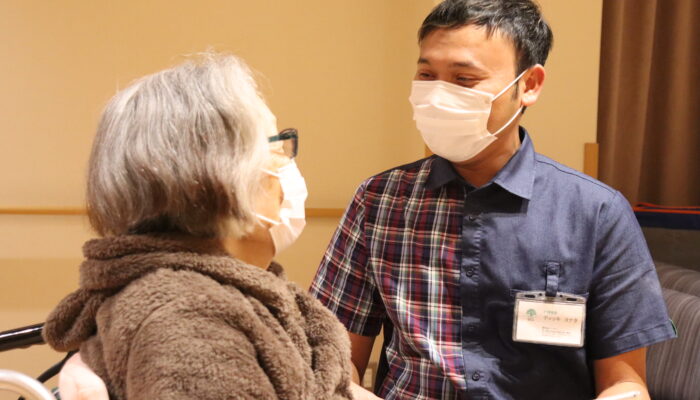
However, foreign care workers are playing important roles not only in elderly care facilities but also in settings where medical and care services collaborate—such as hospitals, clinics, health care facilities for the elderly, and rehabilitation day care services.
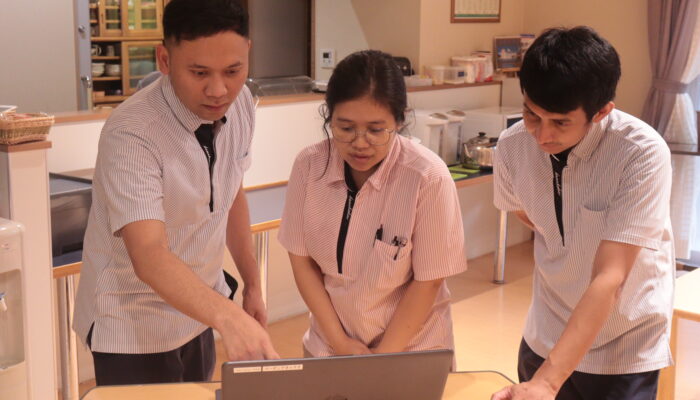
In these settings, care staff work alongside medical professionals including doctors, nurses, and physical therapists to provide care for patients and service users.
Care staff working in hospitals are positioned as nursing assistants or nursing aides. While they cannot perform medical procedures such as administering injections, they serve as essential members of the medical team through providing physical care to patients, life support, and assisting nursing staff. Through this division of roles, patients receive better quality care.
In this article, we conducted interviews with four foreign care workers actually working in such settings, as well as the Japanese staff supporting them. We share their voices about the unique rewards of working where medical and care services collaborate, their daily work content, and the support systems provided for foreign care workers.
Contents:
Institution that cooperated with the interview: Nishinaka Medical Association
A medical corporation based in southern Osaka City that provides seamless medical care, nursing care, and home support services. Centered around Nishinaka Hospital and Nishinaka Health Care Facility for the Elderly in Higashisumiyoshi Ward, Osaka City, they operate day rehabilitation facilities, home-visit care services, care plan centers, and regular and on-demand home-visit care and nursing service.
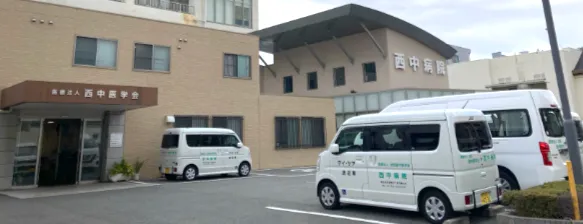
Foreign Care Workers at Nishinaka Medical Association
Ms. Nguyen Phung Khanh Linh (Linh; from Vietnam): Arrived in Japan 2016, works at hospital
Ms. Tran Thi Anh Mo (Mo; from Vietnam): Arrived in Japan 2019, works at long-term care health facility, certified care worker
Ms. Nguyen Thi Thanh Thuy (Thuy; from Vietnam): Arrived in Japan 2022, works at day rehabilitation center
Mr. Muhammad Akbar Resardi (Akbar; from Indonesia): Arrived in Japan 2022, works at day rehabilitation center
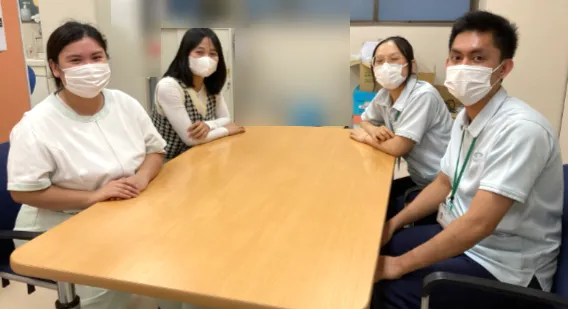
From left: Linh, Mo, Thuy, Akbar
――Can each of you share how you started working in nursing care in Japan?
Mo:
I cared for my grandmother in Vietnam. I came to Japan as a technical intern trainee in 2019. Later, when I switched to the Specified Skilled Worker visa, the registered support organization introduced me to my current facility. When I toured the facility, I saw staff helping each other while working. I thought that atmosphere was really wonderful.
Thuy:
After coming to Japan, I attended a Japanese language school in Nagoya for one year. After that, I started working at a facility for people with disabilities in Nagoya. At that facility, there were many service users who didn’t talk much, and I wanted to communicate more with users. So I decided to move to Osaka where I had many friends. I was introduced to several facilities, but I liked the atmosphere of Nagai Park near this facility very much, so I decided to work here.
Akbar:
I came to Japan to study at a Japanese language school in Hyogo Prefecture. During my studies, I was looking for a part-time job, but since the school was in the mountains, there was only a nursing home nearby. So I worked part-time at a special nursing home, but as I worked, I found care work interesting, so I decided to pursue care work.
Linh:
I came to Japan as an international student in 2016 and studied to become an interpreter at university. After graduating, I worked as an interpreter for technical intern trainees in care at a supervising organization. Eventually I wanted to do care work myself, so I switched my visa from “Engineer/Specialist in Humanities/International Services” to “Specified Skilled Worker (Nursing Care).”
I chose this facility because during the interview, I heard that there were foreigners who had been working continuously for 2-3 years or more, and I felt that I could work together with Japanese staff without discrimination between Japanese and foreigners.
――Please tell us specifically about your work at each facility.
Thuy:
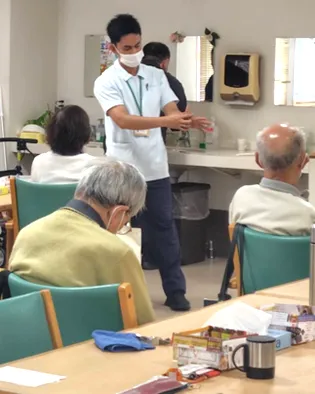
At the day rehabilitation center, the work content differs depending on what you’re assigned for the day. On days when I’m assigned to bathing, I assist with baths almost all day, and there are days when I’m in charge of recreation and exercise. Sometimes I’m responsible for picking up and dropping off service users, and sometimes I accompany them to doctor’s examinations.
There are many energetic service users, so talking with them is very enjoyable.
Akbar:
At the day rehabilitation center, there’s even a 104-year-old service user, but for people who can walk on their own, we have them walk using their own strength. This reflects the Japanese philosophy of care.
Mo:
At the health care facilities for the elderly, there are four shift patterns: early shift, day shift, late shift, and night shift. Basically, we provide the care that service users need in their daily lives, but the work content varies depending on the shift and assignment. For example, things like cutting users’ nails are done by nursing staff. In Vietnam, family members do this, so I was surprised at first.
Linh:
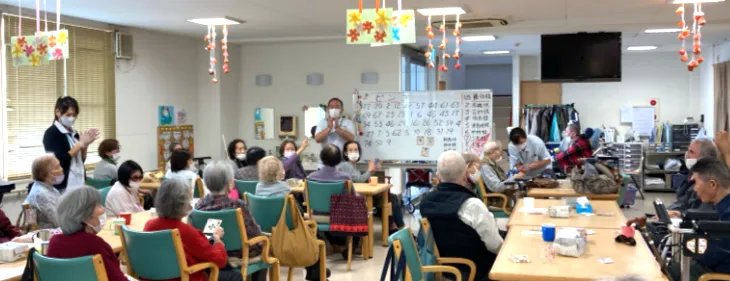
I work at a hospital. Hospital patients live in four-person rooms, and many are bedridden. In the morning, there’s handover, diaper assistance, and sheet changing. At lunch, I assist with meals, and in the evening, I respond to nurse calls. Also, we provide bathing assistance three times a week. During night shifts, I assist with dinner meals and diaper changes, and handle handover to the day shift staff the next day. Medical procedures like phlegm suctioning are handled by nurses. Those are not part of our role.
――Linh, I heard you previously worked at a group home. Are there differences?
Linh:
When I was working as an interpreter at a group home, when service users became ill, they would be hospitalized, and afterward I didn’t know what happened to them. The work content at the hospital is more difficult than at the group home, but I can learn more deeply about Japanese care and medical care, so I wanted to challenge myself. When I saw seriously ill patients become well, I was truly happy, and I became curious about what kind of care could help them get better.
――Were there difficult times at first?
Mo:
At first, I didn’t know the correct way to provide care, and I hurt my back because I didn’t know the proper way to provide care. Since then, I’ve been especially careful about proper care methods.
Thuy:
The Japanese used at work was difficult. When I was leading recreation activities in front of service users, I had trouble because the Japanese I wanted to say didn’t come to mind.
Linh:
At the hospital, we also perform post-mortem care for deceased patients, but the first time I saw a deceased patient’s face, I was shocked. This was something I couldn’t experience at the group home.
Akbar:
There are few people with dementia in Indonesia, so I was surprised that there are many people with dementia in Japan. At first, I didn’t understand the behavior of people with dementia well, and I often didn’t know how to respond.
Mo:
At first, I was also scared because service users with dementia would suddenly get angry or raise their voices. When a service user strongly told me “I want to go home,” even when I tried to persuade them they wouldn’t listen, and I was even told “call the police.” At times like that, seniors and colleagues taught me what to do, and I gradually learned how to respond.
Linh:
I think I’ve become more patient through care work (laughs). Previously, when I saw elderly people being selfish, I would sometimes get irritated, but through care work I came to understand elderly people, and I began to think “why is this person saying such things?”
Akbar:
I’ve also changed. Since starting care work, when I see elderly people crossing the street in town, I watch over them carefully. I think I’ve leveled up as a human being (laughs).
――Mo, you passed the certified care worker national examination this year. How did you study?
Mo:
I bought textbooks myself and studied. And I solved many past national examination questions. I think solving many problems is the most important thing.
Thuy:
I plan to take the 38th national examination in January 2026. There’s an online community where Vietnamese people who have lived in Japan for a long time and obtained the certified care worker qualification teach us, which is very helpful.
――Finally, please give a message to people overseas who are considering working in care in Japan.
Linh:
The work is very busy, but I think it’s work where you can learn various things and is worth challenging yourself.
Akbar:
Communication with people around you is important, so you need to study Japanese well. If you work hard, the people at your workplace will definitely support you.
Thuy:
I continue care work because I enjoy talking with service users. I want people to treat service users politely like their own family.
Mo:
Japanese care facilities have well-equipped work environments. If you obtain the certified care worker qualification, your opportunities will expand further. Please take on the challenge.
Words from Ms. Hiramatsu, who supports foreign care workers at Nishinaka Medical Association
Our corporation has been preparing for the acceptance of foreign care workers early on, anticipating future labor shortages. What I value most is creating an environment where people who have come from distant countries can easily talk when they have troubles or concerns. We work with registered support organizations to establish a system where they can consult easily. Since they come to unfamiliar Japan alone and must be anxious, I feel it’s important to work together with registered support organizations to address even small anxieties about daily life and stay close to foreign care workers. Also, if they obtain the certified care worker national qualification, they can continue working in Japan with their families for a long time. For those aiming to obtain the certified care worker qualification, we provide solid learning support such as opening Japanese language courses and certified care worker national examination preparation courses. My greatest wish is that since they’ve come all the way to Japan, I want foreign care workers to work happily with smiles. I believe that creating an environment where they can work with peace of mind and enthusiasm will ultimately lead to improving the quality of medical care and nursing care for the entire corporation.